


Maintaining consistency across locations is one of the major challenges growing brands face. As brands expand, keeping locations aligned on standards, workflows and customer expectations becomes harder, which makes operational discipline increasingly important.
That’s where operational excellence comes in.
Operational excellence is the discipline of building a business that runs reliably, efficiently, and profitably no matter how many locations, employees, or moving parts you manage. It works by creating systems that keep standards high, teams aligned, and performance predictable, even as you scale.
It’s not a buzzword. Operational excellence is the framework that makes it possible.
It provides a repeatable approach for improving reliability, team readiness and measurable execution as a multi-location footprint becomes more complex.
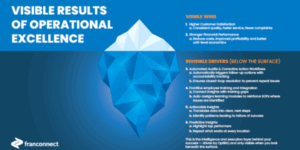
What Is Operational Excellence in Franchise Growth?
Operational excellence is the continuous pursuit of improved efficiency, reliability, and effectiveness across all facets of the business.
For multi-location brands, it means going beyond compliance to build systems and behaviors that support quality, efficiency and more consistent execution as the organization grows.
And when done right, the results are clear:
- 20–30% decrease in revenue lost to operational inefficiencies
- 25% improvement in compliance scores
- 18–20% increase in unit-level economics
At its core, operational excellence gives teams a repeatable way to manage complexity. Systems that improve visibility, accountability and responsiveness can make execution easier to measure and refine, but they do not turn growth into a formula.
With stronger structure and visibility, multi-location brands can make it easier for locations to work toward consistent standards while giving leaders better information about where execution differs and where support is needed.
Why Operational Excellence Matters
To be brief, customer expectations have changed.
According to the survey, 73% of Americans are likely to abandon a brand after just one poor customer service experience. With nearly three-quarters of consumers now willing to abandon a brand when customer service is poor, patience for poor customer service by consumers is running perilously thin.
Inconsistent service, missed standards or disjointed processes can erode trust in a brand. Operational-excellence practices can improve visibility into those risks and give teams a more structured way to address them, although no operating system can prevent every poor customer experience.
With the right systems in place, brands can:
- Deliver consistent experiences at every location
- Improve efficiency and reduce manual work
- Empower frontline teams to take action
- Scale faster without losing control
When locations work from common standards and workflows, leaders can gain clearer visibility into execution and frontline teams can have more consistent guidance. Customer experience may become more consistent when those processes are well designed and adopted, but the outcome should be measured rather than assumed.
Common Roadblocks on the Path to Excellence
Disconnected Systems
Training, quality and performance tools often live in separate platforms, spreadsheets or email. Fragmentation can make it harder to build a timely, reliable view of operations because teams may need to reconcile information across systems.
Limited Visibility Across Locations
Customer complaints and monthly P&Ls are useful signals, but they may surface issues later than operational data does. More timely visibility can give leaders additional context for coaching and course correction.
Inconsistent Onboarding and Training
Without standardized onboarding and continuous learning, new hires get mixed messages, or no training at all, leading to uneven performance and higher turnover.
The Four Pillars of Operational Excellence
Operational excellence doesn’t come from a single process. It’s built on four interconnected pillars that drive consistency, accountability, and performance across every location.
Pillar #1: Standardize Core Operations
Consistency starts with structure.
Establish repeatable processes and clear expectations across every location using standardized checklists, SOPs, audits, and workflows.
A shared playbook can support more consistent execution across teams. Whether that translates into a better customer experience depends on how the standards are applied, adopted and measured in practice.
What it looks like:
- Prebuilt digital audits and task lists
- Centralized SOPs and operational documentation
- Clear, repeatable processes for recurring activities
Pillar #2: Enable and Train Teams
Operational excellence depends on your people.
Give teams the knowledge, tools and support they need to perform. Role-based onboarding, microlearning and ongoing coaching can help employees understand expectations, build skills and become more consistent over time.
What it looks like:
- Digital onboarding tied to roles
- Targeted microlearning modules
- Field coaching and performance tracking
Pillar #3: Act on Data
Dashboards, location scorecards, and tools like Frannie AI help you identify what’s working and what’s not. Instead of waiting for issues to appear in reviews or revenue reports, operators can catch problems early and act in real time.
What it looks like:
- Real-time performance dashboards
- Automated alerts and follow-ups
- Predictive insights to guide decision-making
Pillar #4: Close the Loop
Turn insights into action.
Operational excellence relies on identifying problems and creating processes to solve them. By connecting audits, training, and performance data, you create a continuous improvement loop that strengthens your culture and results.
What it looks like:
- Evaluation results triggering targeted training
- Trackable action plans and resolution workflows
- A coaching-first culture, not a policing one
Together, these four pillars create the structure every growing brand needs to scale with confidence. When they work together, teams know what’s expected, leaders see what’s happening in real time, and every location delivers the same dependable results.
The Journey Toward Operational Excellence
Every brand is somewhere on the journey toward operational excellence, and that journey rarely follows a straight line. It begins with foundational processes, often manual and inconsistent, where visibility is limited and leaders are forced to react to issues rather than anticipate them.
As brands mature, they begin to introduce structure: digital checklists, standardized tools, and early efforts to unify operations. This responsive stage brings progress, but teams often still rely on lagging indicators and siloed systems that make it difficult to see the full picture.
Momentum builds in the proactive stage, where systems start to integrate, data becomes central to decision-making, and coaching replaces correction as the dominant management style. Here, leaders begin to spot issues before they affect customers and operations shift from reactive to strategic.
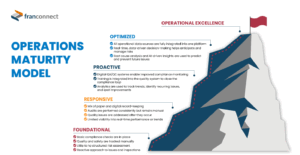
A more mature stage—what we call “optimized operations”—uses connected workflows, automation, AI and analytics to help teams identify patterns, prioritize attention and respond more efficiently. These capabilities can support earlier intervention, but predictive signals should be validated and used as decision support rather than treated as certainty.
Brands can sit at different points across this maturity model, and different functions within the same organization may mature at different rates. The goal is not overnight transformation; it is steady improvement in visibility, consistency, follow-through and the ability to learn from operating data.
Customers may experience the downstream effects of stronger operations through more consistent service or fewer execution gaps. Those outcomes depend on how the underlying systems, training and management practices work together, so they should be validated with customer and performance data.
Ready to Build Your Own Path to Excellence?
As a Chief Operating Officer, you play a crucial role in shaping how your brand delivers, grows, and scales. On top of overseeing daily operations, our role includes driving efficiency, aligning processes with strategic goals, and ensuring the brand thrives in a constantly evolving industry.
To help, we’ve created a free resource ‘The Operational Excellence Playbook for COOs.’
Inside, you’ll learn how leading brands use operational excellence to:
- Drive efficiency and accountability across every location
- Empower frontline execution
- Align daily operations with long-term strategy
Download this free playbook today to learn how to create systems that scale, empower teams to perform, and turn operational excellence into a lasting competitive advantage.