










By

Kelsey Smith
Two women interview with each other over coffee

Questions to Ask During an Interview Between a Franchisor and a Franchisee

Relationships are crucial to starting any successful franchise. During the initial interview with a franchisee, you want to learn about their business approach. After all, this person will be your partner for the foreseeable future.

Like a traditional job interview, this discussion should be a two-way street. The franchisor and franchisee should evaluate each other to determine if they would be a good fit. To help you make this decision, we’ve compiled some hard-hitting franchise interview questions and answers.

Questions a Franchisor Should Ask a Franchisee

First, here are questions for a franchisor to ask a franchisee. Your job as a franchisor is to determine whether this person will likely succeed in operating a unit for your franchise. While the criteria will look different for everyone, these questions can help you zero in.

1. Why Does This Type of Franchise Interest You?

When someone wants to be a franchisee, they often have multiple franchisors in mind. This question can reveal their passion for a specific industry or brand. Maybe they’ve eaten at your restaurant since childhood or see a potential unmet demand for your services. Excitement and genuine interest often rub off on other people and can help the franchisee network, hire passionate employees, and represent the brand well.

2. Where Do You Plan on Opening This Franchise?

Depending on how your franchise handles location planning, your franchisee may already have a spot in mind — bonus points if it’s in their hometown. A franchisee can lean on existing connections and possibly even a local reputation by opening a location in their community. If they’ve already found a location, they’ve simplified part of your job so you can maximize sales with a unit that hits the ground running.

3. Have You Ever Served in a Leadership or Management Position?

While franchise experience isn’t always necessary, some leadership or management skills will help. The franchisee will have many employees reporting to them, even if they hire a manager to handle day-to-day operations. Understanding this responsibility and the unique dynamics of management is crucial.

4. Do You Have Experience in the Industry This Franchise Falls Into?

Part of the appeal of a franchise is that the franchisee doesn’t need to build from the ground up. They benefit from the existing brand and any training or support you can offer. Still, you will want to know if they have experience that will help them in the role, like work in the industry, a business degree, or employment at a similar business.

5. Have You Ever Been a Franchisee Before? If So, for What Franchise?

Some franchisees have previously owned a franchise unit, so it’s worth asking about. They may be familiar with the structure and primed to dive in. If the franchisee had an unsuccessful experience with a franchise, ask about what they learned. Failure is often the best teacher, so don’t count them out.

Open Locations Faster

6. What Makes You a Good Fit for This Franchise?

Like most jobs, your franchisee needs to be a good fit with your franchise’s values and beliefs. Someone who embodies your franchise brand can help you succeed. If they align with the company, you will likely find a better working relationship, too.

Helpful features of franchise management software

Questions a Franchisee Should Ask a Franchisor

If you’re on the other side of the table and looking for questions to ask when franchising, you’ll also need to ensure the franchisor is a good fit. You’ll invest a lot in this partnership, so make sure it’s mutually beneficial and aligns with your goals. Here are some examples of what to ask when buying a franchise.

1. What Are Your Royalties and Fees?

This first question to ask a franchisor before buying will significantly affect your finances. Franchises can have wildly different royalty and fee structures, so make sure you understand your ongoing and startup costs. Royalties are typically a percentage of your revenue, while initial franchise fees cover startup costs like licensing and support staff. Ask about other ongoing fees, such as tech support or marketing.

2. What Type of Technology or Software Do You Use?

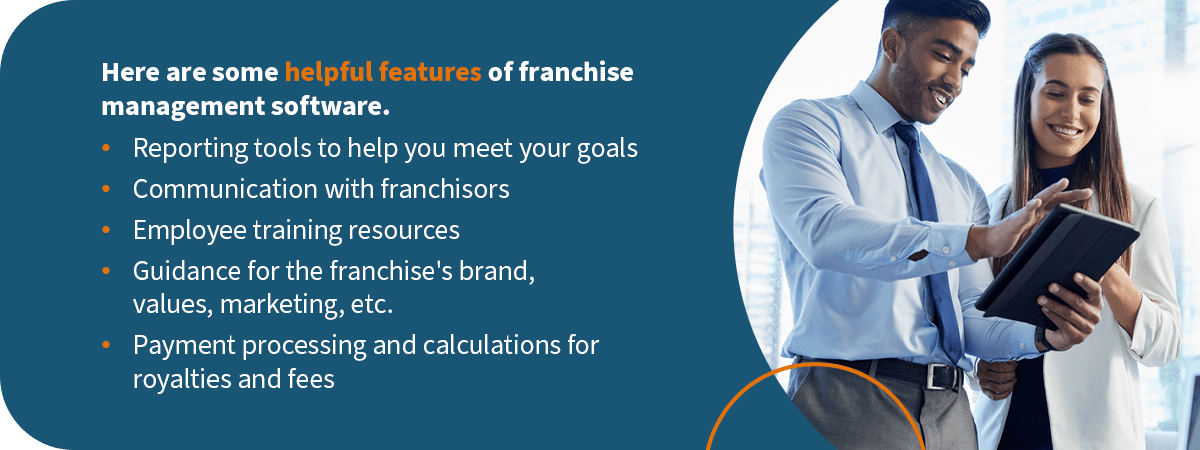
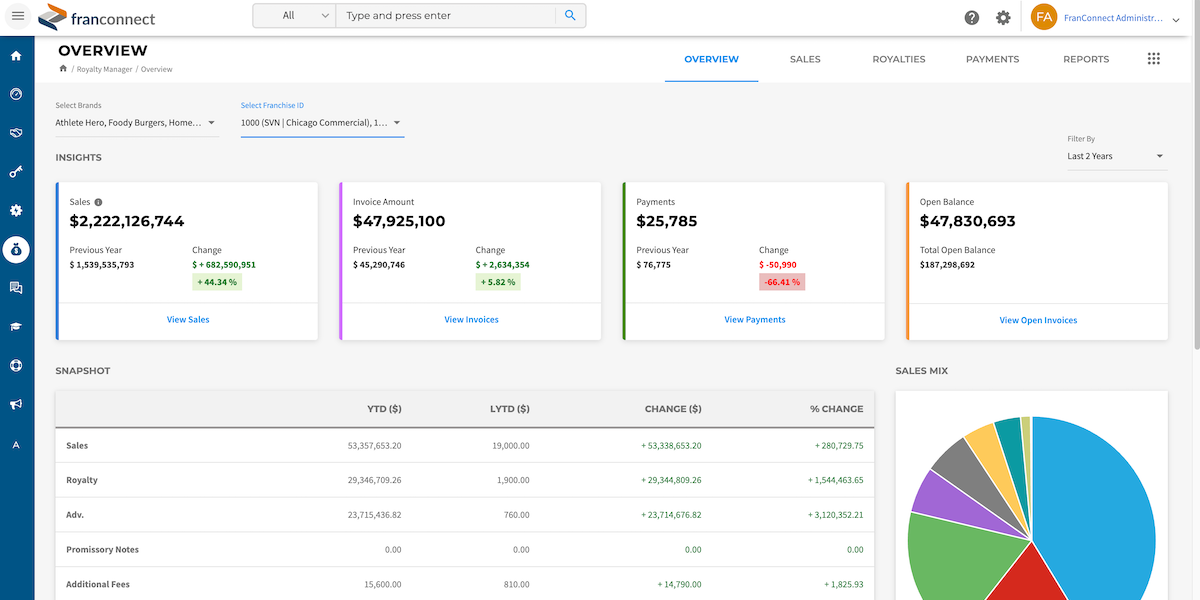
The technology behind a franchise can significantly impact your day-to-day operations. From point-of-sale systems to accounting software, ask about what you can expect. One of the most impactful programs for the franchisee is the franchise management system. This platform determines how you interact with the franchisor and manage your unit. Here are some helpful features of franchise management software.

  • Reporting tools to help you meet your goals
  • Communication with franchisors
  • Employee training resources
  • Guidance for the franchise’s brand, values, marketing, etc.
  • Payment processing and calculations for royalties and fees

If your franchisor doesn’t have a franchise management platform yet, FranConnect has various features to help you and your franchisor succeed.

3. What Goes Into the Location Selection Process?

Some franchisors already have locations selected or retain the right of final approval. Others are a little more relaxed. Talk to your potential franchisor about their approach. You may be able to choose your location or get help from to find one.

Another valuable topic to discuss is how the franchise manages territories. If you open a location and the franchisor allows someone else to open another right down the road, the second location could threaten your success. Many franchisors offer exclusive territories to protect you from these situations.

4. Do You Offer Ongoing Support and Training?

One question to ask a franchisor before buying is what kind of support you can expect. Some franchises are more hands-on than others. If you’re new to franchising, a supportive franchisor might be preferable to one that gives you more freedom.

Consider areas like training, marketing, and tech support. Look for a franchisor who offers assistance that aligns with your comfort level.

5. Can You Give an Estimate to the Total Investment Needed to Open a Franchise?

We already mentioned initial franchise fees, which are only part of the startup costs. Other expenses might include:

  • Real estate purchases or renovations
  • Professional services, such as lawyers and contractors
  • Equipment, furniture, and supplies for general operations
  • Insurance, including workers’ compensation, property and auto insurance

Ask the franchisor for a ballpark estimate of what you can expect.

Use FranConnect to Manage Your Franchise

Whether you’re a franchisor or a potential franchisee, the right technology can significantly affect your experience. FranConnect offers various franchise management tools, from training resources to payment processing and reporting.

Request A Demo

Before you dive into your next partnership, consider how FranConnect can set you up for success. Request a demo to see it in action or call us toll-free at 844-336-1017 for more information.

A young woman wearing red lipstick works on a laptop

How Businesses Can Benefit From Using Business Analytics

Understanding your company’s performance is vital for business owners since it helps them make critical decisions for the future. That’s where business analytics comes in. Business analytics provide detailed insights that make it easier to measure your company’s performance, establish actionable steps to achieve your business goals and solve reoccurring problems within your business. This post will explain how data analytics helps your business expand and thrive in a competitive market.

What Is Business Analytics?

Business analytics is a method of interpreting data to find valuable performance patterns and insights. Examples of business analytics tools and techniques include machine learning, predictive analytics, and natural language processing. These tools transform data analytics into usable insights to determine your website’s performance. You can use these insights to make decisions and improve your marketing strategies to reach more people.

Analytic tools need clear and accessible data to provide real-time, accurate business analytics. Several tools and cloud storage software platforms exist to access and process your vital data to provide valuable business insights.

How Can Businesses Benefit From Using Analytics?

Identifying patterns and trends in your business data helps you find ways to change your business practices for a more favorable outcome. Here are a few specific benefits of business analytics:

Improve Customer Insights

Your goal as a business is to improve your customers’ experience when they use your products or services. However, it may be challenging to enhance their experience if you know how they feel. Business analytics tools analyze data to create detailed customer profiles, allowing you to understand individuals’ behavior to provide tailored services to meet their unique needs and preferences.

Track KPIs

Key performance indicators (KPIs) are quantifiable measurements that evaluate your company’s long-term performance and can determine your strategic, financial, and operational achievements compared to other companies in the same industry. Business analytics track your company’s performance metrics by collecting data and converting it into measurable insights you can display on charts and dashboards.

Simplify Decision-Making

As a business owner, you have many decisions to make every day. Business analytics can provide insights that guide you in making informed decisions. Business analytic tools use predictive analytics to suggest the best responses to changes in your business. These tools can use sales data to determine the chance of success, helping you decide on your company’s right course of action.

Request A Demo

Mitigate Business Risks

You are likely no stranger to business risks. Legal liabilities, employee safety, and delayed deliveries are just some risks your business may experience. Business analytics models can evaluate business data, such as your location, product demands, and current inventory, to predict potential risks and allow you to prevent them. Business analytics can also help you recover from setbacks by recommending a suitable solution.

Enhance Data Security

In addition to mitigating risks, business analytics tools can also identify security vulnerabilities and help you protect your data. Some data analytics models can use information from previous data breaches to strengthen security and prevent recurrence. Investing in business analytics solutions will help you protect your company’s sensitive information and maintain compliance with privacy regulations.

How Can FranConnect Benefit Your Business?

At FranConnect, we offer analytics solutions for franchises and multi-location businesses. FranConnect’s Analytics includes a catalog of pre-built analytics to provide your company’s development, operations, and finance teams with valuable insights that streamline decision-making. We use scorecards, benchmarks, and dashboards to represent your company’s performance, allowing you to increase profitability and strengthen your brand.

FranConnect’s Analytics catalog has a user-friendly design to ensure you get the most out of our tool. We have optimized the catalog’s dashboard and scorecard to be mobile-friendly so you can access your data no matter where you are. Experience all the benefits of business analytics with our comprehensive and innovative solutions.

Contact FranConnect for Analytics Software You Can Trust

Would you like to know more about FranConnect’s Analytics and other catalog solutions coming soon? Our experts are happy to assist you with a tailored solution to expand your units. Feel free to request a demo or contact us directly to speak to a member of our sales team.

A woman works on her laptop in a pottery business

Utilizing Google Business Profiles to Grow Your Franchise’s Online Presence

Most of us are past the point of thinking, “What would we do without the internet?” It’s transcended novelty to become, simply, a normal part of life. As a franchisor, you understand the necessity of harnessing the power of online marketing for your units. One way of doing this is setting up a Google Business Profile for each.

With Google Business Profiles (GBP), potential customers can absorb everything they need to know about a business without a single click after the initial Google search. Explore Google Business Profile features and how to list your franchise locations on Google.

What Is a Google Business Profile?

A Google Business Profile appears on the right side of your computer screen when you Google a business. On a mobile device, it will appear near the top or at the top of the search engine results page (SERP). GBPs reveal vital information about a business, such as:

  • Location
  • Hours of operation
  • Phone number
  • Website
  • Service area

Creating Google Business Profiles is essential for improving local search engine optimization (SEO), which helps local businesses rank higher in SERPs. Each of your franchise units should have its own Google Business Profile. When customers search for your business, they’ll find a location nearest them. For example, a person on a work trip might Google their favorite hometown chain restaurant to find a dinner spot.

Helping your customers find locations near them that serve their needs can boost leads and sales for your franchise units.

How Google Business Profiles Can Benefit Franchises

Google Business Profiles are beneficial for businesses in any industry. Take these examples:

  • Gyms: Those who belong to a gym with multiple locations may need to find somewhere to work out when they’re out of town for a work trip or headed to college. Additionally, prospective members can Google local gyms to find the closest one to them before signing up.
  • Salons: Before making an appointment, people may Google a salon to see their hours and service areas.
  • Restaurants: From a GBP, restaurant attendees can call for reservations, scan reviews and look at photos of dishes.
  • Stores: People needing groceries or a new sweater in a pinch can find an open shop near them with one Google search.

Take a look at some of the features of Google Business Profiles that can benefit franchises.

Features of Google Business Profiles that franchises can benefit from

Call Directly From the Listing

Google Business Profiles often have two places viewers can click to call — a button directly below the franchise name and a clickable phone number further down in the listing. Whether people have a question about a prescription, an appointment, holiday hours or specific services, all they have to do is Google the business name to find a phone number.

Request Directions to the Franchise Location

Clicking the “Directions” button under the franchise’s location leads viewers to Google Maps, where they can get directions to a business. This feature is especially convenient for travelers, people who have recently moved or those of us who aren’t great with directions.

Ensure Brand Consistency

Click to View the Franchise Website

Another button is the “Website” link, which leads directly to the company website. Easy access to a business website allows users to explore products, services, sales and company information when they don’t know a URL by heart.

Leave Customer Reviews

Reviews are one of the most valuable components of a Google Business Profile. Google displays an average star rating near the top of the listing, and farther down, individuals can browse these reviews, as well as company responses to them. People can also write reviews, which makes interacting with a brand easy.

How to Create a Google Business Profile for Your Franchise

You can create a Google Business Profile via Google Maps. After signing into Google Maps, choose between these options:

  • Use the search bar to search your company address and click “Add your business” on the left of the Business Profile.
  • Click “Add your business” after right-clicking anywhere on the map.
  • Click the menu in the top left of the screen, and click “Add your business.”

As mentioned, you’ll want to create a Google Business Profile for each one of your franchise locations. Make sure to enter the company name exactly the same for each GBP — you should not change the business name unless your company’s real-world names vary based on location. The business category should also be the same for each franchise unit.

To edit your business profile on Google, search for it on Google Search or Google Maps and click “Edit profile.” From here, you can update your hours, change your phone number, or add or remove photos from your Google Business Profile.

How to Add Users to a Google Business Profile

You may not have time to manage every GBP yourself — and that’s OK! You can designate people to manage specific profiles. The owner creates the account and can invite other users to become owners and managers, the difference being that only owners can add or remove users.

To add users to your Google Business Profile:

  1. Click “Menu” on your Business Profile.
  2. Click the symbol for adding users in the top left.
  3. Enter a name or email address.
  4. Choose “Owner” or “Manager” under “Access.”
  5. Click “Invite.”

How to Add Social Media Links to Your Google Business Profile

Social media is a fantastic place for users to learn more about your franchise units. In some regions, you may be able to add your social media links like your LinkedIn profile to your Google Business Profile:

  1. Click “Edit profile” on your Google Business Profile.
  2. Navigate to “Business information” and then “Contact.”
  3. Click “Social profiles.”
  4. Click the down arrow for a drop-down menu of possible social media links.
  5. Select the profiles you’d like to add, and add the link to your profile.
  6. Click save.

How to Optimize Your Google Business Profile

Once you’ve created your GBP, the next step is to optimize it. Start with these tips:

  • Ensure everything is accurate: Inaccurate information may result in franchise units not showing up in SERPs or customers showing up to a business when it’s closed. Ensure all information is accurate for the best online experience.
  • Add images: Photos give people a glimpse into a company’s interior or confirm a business location is where they think it is. Photos can also show menu items and products.
  • Ask for reviews: Honest reviews can tell you what one franchise is doing well and where others can improve. Make sure to have your GBP managers respond to all reviews — not just the positive ones.
  • Link to social media profiles: When prospective customers want to learn more about a business, there’s no better way than through a Facebook or LinkedIn page.
  • Utilize the post feature: Posts allow businesses to update customers about information like sales, changes in hours or updated phone numbers.

Boost Your Franchise Sales Performance With FranConnect’s Software

As a franchisor, your goal is to see growth in all of your franchise units. To help this overwhelming job become a reality, many franchisors turn to FranConnect.

Contact Us
FranConnect is the leading franchise management software that helps businesses drive growth and improve operational performance. Request a demo from FranConnect or call 833-438-7523 to connect with one of our franchising experts and see how FranConnect helps companies grow 44% faster on average than the broader franchising market.

Request a demo of FranConnect's tool suite

A cartoon hand holds a magnet that attracts customers

3 Keys to Attract a Qualified Audience for Your Franchise Development Process

Whether you are a growing franchise or managing a multi- brand, large corporation, you need to spend your time on what matters. You know technology can help you be more efficient and effective, but there are also old-school principles which are important to master.

(more…)

A restaurant owner talks to the head chef during a meeting

How to Do Ongoing Franchisee Monitoring Right

As franchise owners, you know that franchisee engagement can have a material impact on the bottom line. A study of 300 brands from Franchise Business Review and InGage Consulting found that engaged franchisees are 3.7 times more profitable than non-engaged franchisees.

(more…)

A man uses a calculator in a car dealership

Automotive Franchises: Sample Objectives and Key Results (OKR)

Automotive franchises make a significant impact on the economy. According to IBISWorld, there are 263,000 auto mechanic businesses running in the U.S., with industry employment counting over 500,000. Although the changing landscape is affecting these businesses, they are still making a meaningful contribution to the economy.

(more…)

1 13 14 15 16 17 38
en_AUEN_AU